NTU vs FNU: Turbidity Units Compared (EPA 180.1 vs ISO 7027)
October 28, 2026
COD vs BOD vs TOC: What Each Measures & When to Use It
October 28, 2026
Optical vs Membrane Dissolved Oxygen Sensors Compared
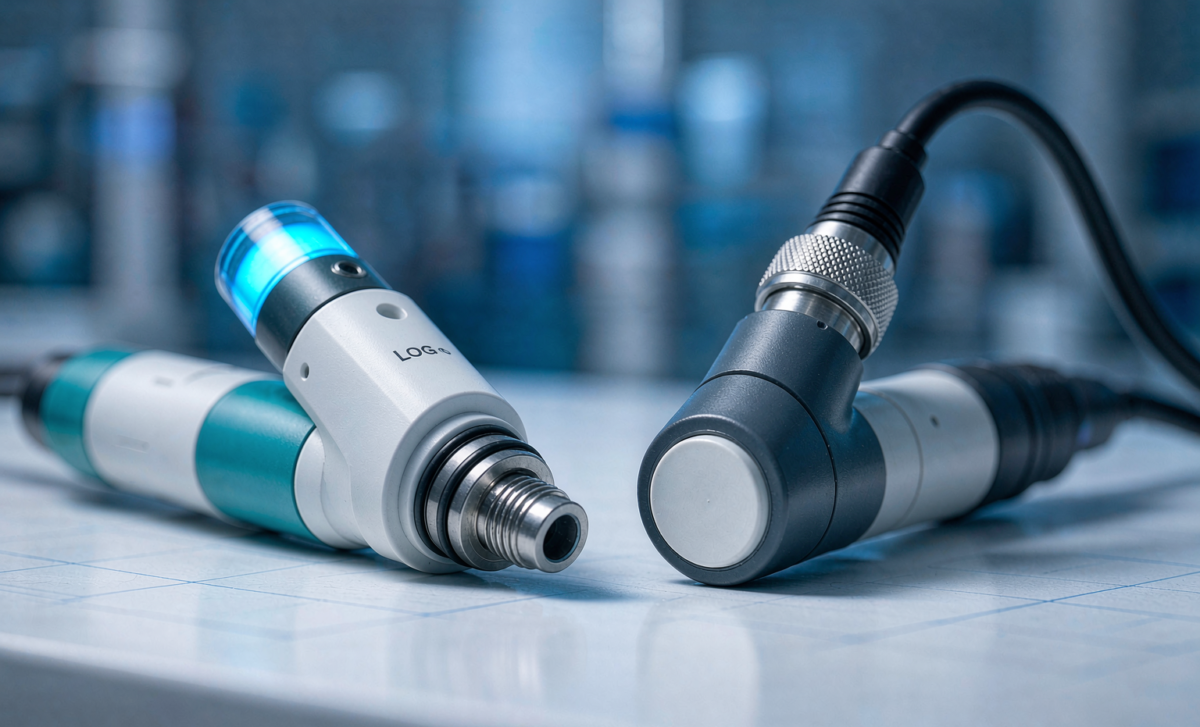
Dissolved oxygen is the one parameter where the sensor technology you choose changes your maintenance schedule more than your accuracy. Optical dissolved oxygen sensors and classic membrane (Clark cell) electrodes both measure the same thing to comparable accuracy when freshly serviced — the difference shows up over the following months of unattended operation.
How each technology works
Membrane-covered electrochemical (Clark cell)
Oxygen diffuses through a membrane into an electrolyte behind it and is consumed at a polarized cathode. The resulting current is proportional to the oxygen arriving at the cathode. Because oxygen is consumed, the probe depends on sample movement across the membrane to replenish what it uses — in stagnant water it under-reads. The membrane and the electrolyte are consumables with their own service intervals.
Optical (luminescence quenching)
A blue light pulse excites a luminescent dye in a cap behind an oxygen-permeable layer. Oxygen quenches the glow, and the sensor reports the quenching as a lifetime measurement. No oxygen is consumed, so the reading is essentially independent of flow, and there is no membrane or electrolyte to service — the sensing element is a replaceable cap with a service life typically measured in years.
Side-by-side comparison
| Aspect | Optical (luminescence) | Membrane (Clark cell) |
|---|---|---|
| Consumes oxygen | No — flow-independent reading | Yes — needs sample movement across the membrane |
| Consumables | Sensing cap (years) | Membrane cap + electrolyte (regular replacement) |
| Stagnant water | Reads correctly | Under-reads without flow |
| Unattended stability | Strong — no electrolyte to deplete | Drifts as electrolyte is consumed |
| Maintenance style | Wiper cleaning, occasional cap swap | Membrane change, electrolyte refill, re-polarization |
| Warm-up | Effectively immediate | Polarization time after service |
| Cost profile | Higher probe cost, lower upkeep | Lower probe cost, higher upkeep |
| Typical fit | Rivers, aquaculture, aeration basins, any unattended station | Handheld spot checks, budget builds, laboratory procedures |
Where optical wins
- Unattended stations. No electrolyte to deplete and no membrane to rupture means the failure modes that end a deployment early are simply removed.
- Fouling environments. Pair the optical cap with a mechanical wiper and the dominant error source becomes manageable.
- Total cost of ownership. Over a multi-year deployment, saved membrane kits, electrolyte and site visits usually outweigh the higher purchase price.
Where a membrane probe still makes sense
For handheld spot checks and occasional sampling, a Clark-type probe is cheaper and entirely adequate — the operator is present to maintain it. Some standard laboratory BOD procedures are also written around membrane electrodes, so lab work may keep you on that method regardless of what floats in your reservoir.
Frequently asked questions
Do optical DO sensors need flow across the cap?
No — that is their key advantage. Because the measurement consumes no oxygen, a stagnant reading is valid. Membrane probes under-read in still water for exactly the opposite reason.
How long does an optical cap last?
The luminescent cap is a consumable with a service life typically measured in years, depending on chemistry and abrasion. Check the cap’s expiry when you commission the sensor and record the replacement date in your maintenance log.
Do both technologies need salinity and pressure compensation?
Yes. Oxygen solubility depends on salinity and barometric pressure regardless of the measuring principle, so make sure compensation is enabled and set correctly in either case.
Can I use an optical sensor for laboratory BOD tests?
Follow your method. Many standard BOD procedures are written around membrane electrodes, and laboratories often stay on them for procedural reasons even though optical sensing is technically suitable.
Choosing a DO sensor for an unattended site?
We build optical dissolved oxygen sensors for long-term deployment — no membranes, no electrolyte, wiper-cleaned. Tell us your site conditions and we will recommend a configuration.